
Visibility in AI
Before AI can recommend your company, it has to understand it
What AEO is, what we do differently and how we know it works.
Why this decides things today
People increasingly do not click results, they ask
For twenty years the road to a company ran through a list of blue links. Today part of that road ends earlier: someone asks an AI assistant and gets a single ready answer. If a company is not in it, then for the person asking it simply does not exist. There is no second page of results to fall to any more.
SEO and AEO are two different things
SEO makes sure a site ranks high in search results. AEO, or Answer Engine Optimization, makes sure AI systems can read it, understand it and name it as the source of an answer at all. Classic SEO is not going away and remains the foundation, but on its own it is no longer enough, because some questions never reach the results list.
In practice AEO is a set of specifics
Content that is orderly and readable for machines. Questions and answers marked up as data, ready to be quoted. AI crawlers deliberately allowed onto the site rather than blocked by a provider default. Fast loading, because a slow site tends to be skipped by crawlers. In WebloNeo all of this is built in from day one.
The order has flipped
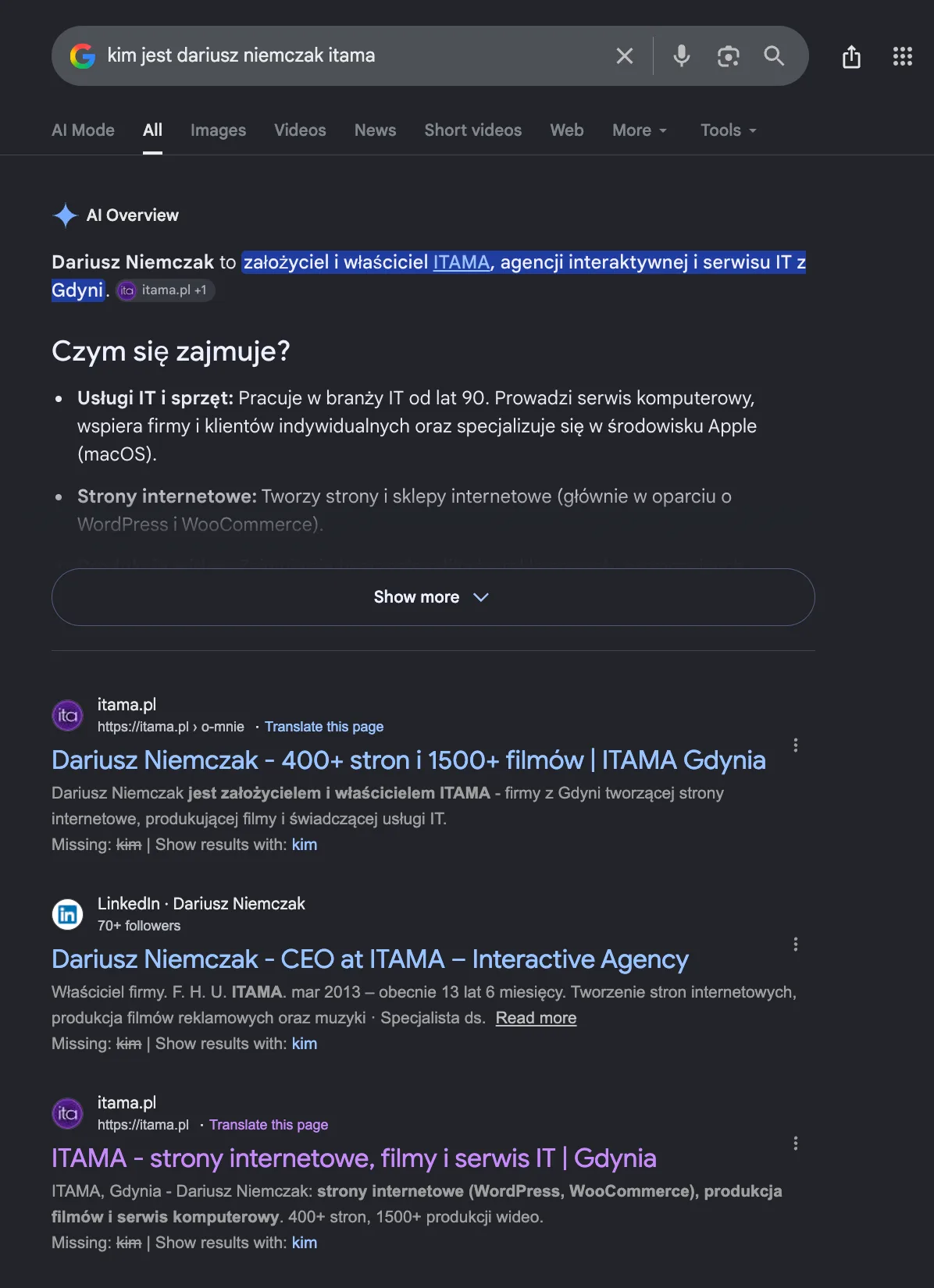
In Google the AI answer comes first, the classic results only below it
Type a question about a company into Google. Right at the top, before the first blue link, an AI Overview block appears: a ready answer composed by the Gemini model, with links to the sources it built it from.
That changes the order in which someone gets to know your company. First place in the classic results is now the SECOND answer the person sees. The first one is written by a model, and it takes its material from pages it can read, understand and quote.
- Gemini first, then ten blue links: The AI block sits above the results, not beside them. More and more often that is where it ends.
- SEO decides whether you are on the list: AEO decides whether you are in the answer above the list. Two different questions.
- A model quotes what it understands: Structured data and answer-shaped content decide who it names as the source.
What that means in practice
An ordinary site versus one prepared for AI
| Topic | An ordinary website | WebloNeo |
|---|---|---|
| Are AI crawlers allowed in | Often blocked by the provider by default, without the owner knowing. | Let in deliberately and verified after launch. |
| Does the model understand what the company does | Descriptive content, with no structured data or only partial. | A complete set of structured data describing the company, services and customer questions. |
| Can the answer be quoted | Answers scattered across paragraphs, so the model has to guess. | Questions and answers marked up as data, ready to be quoted. |
| Do you know that it works | You do not. All you have is the contractor to take at their word. | The panel counter shows every crawler separately with its visit count. |
| What to fix | You have to commission an external audit. | A built-in audit scores the site and lists the specific gaps. |
Proof
You see it in numbers, not on trust
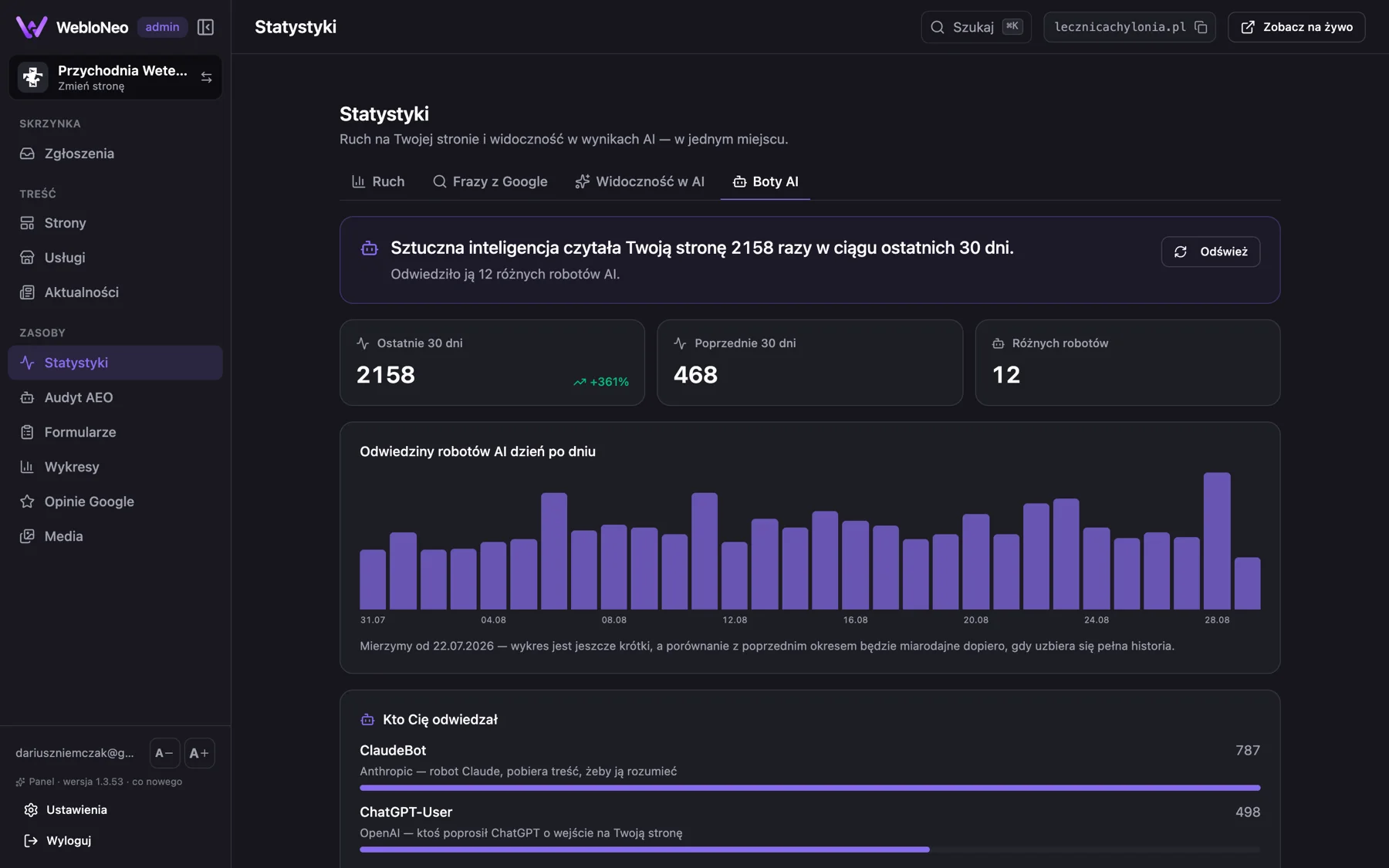
The site measures how many times artificial intelligence crawlers actually reached for it. You do not have to believe claims about visibility in AI, because it is counted day by day.
On one deployment, twelve different AI crawlers visited the site over thirty days, including those behind ChatGPT and Claude, more than two thousand times in total.
What the model sees
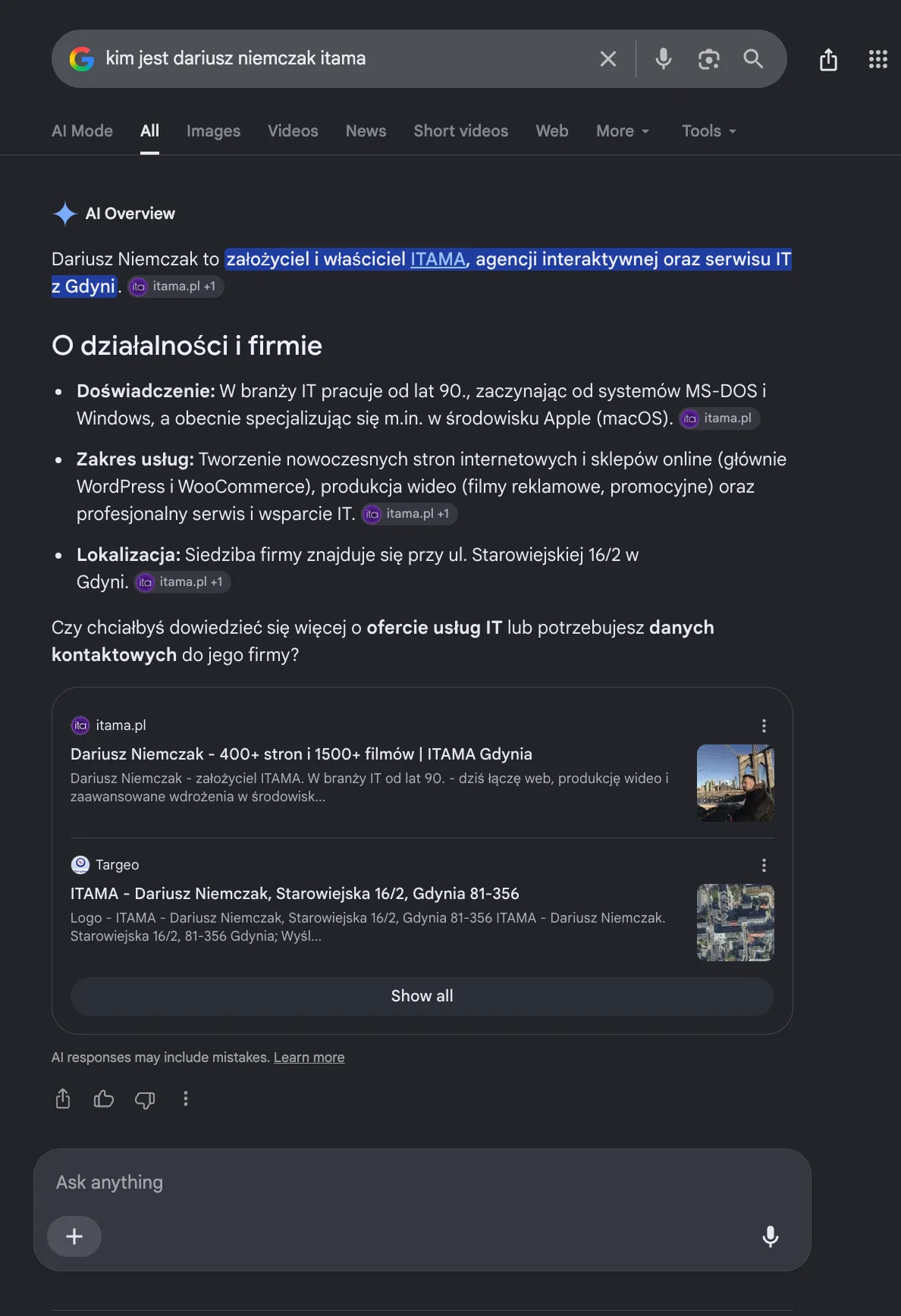
The AI answer is built from what the page stated outright
The expanded AI Overview block shows where the model took each fragment from: scope of services, experience, address. Every piece of information carries a link to the page it came from.
That is the whole mechanism of AEO in one picture. The model does not guess. It quotes what it could read unambiguously, then passes it on as the answer.
Audit
A built-in audit tells you what to fix
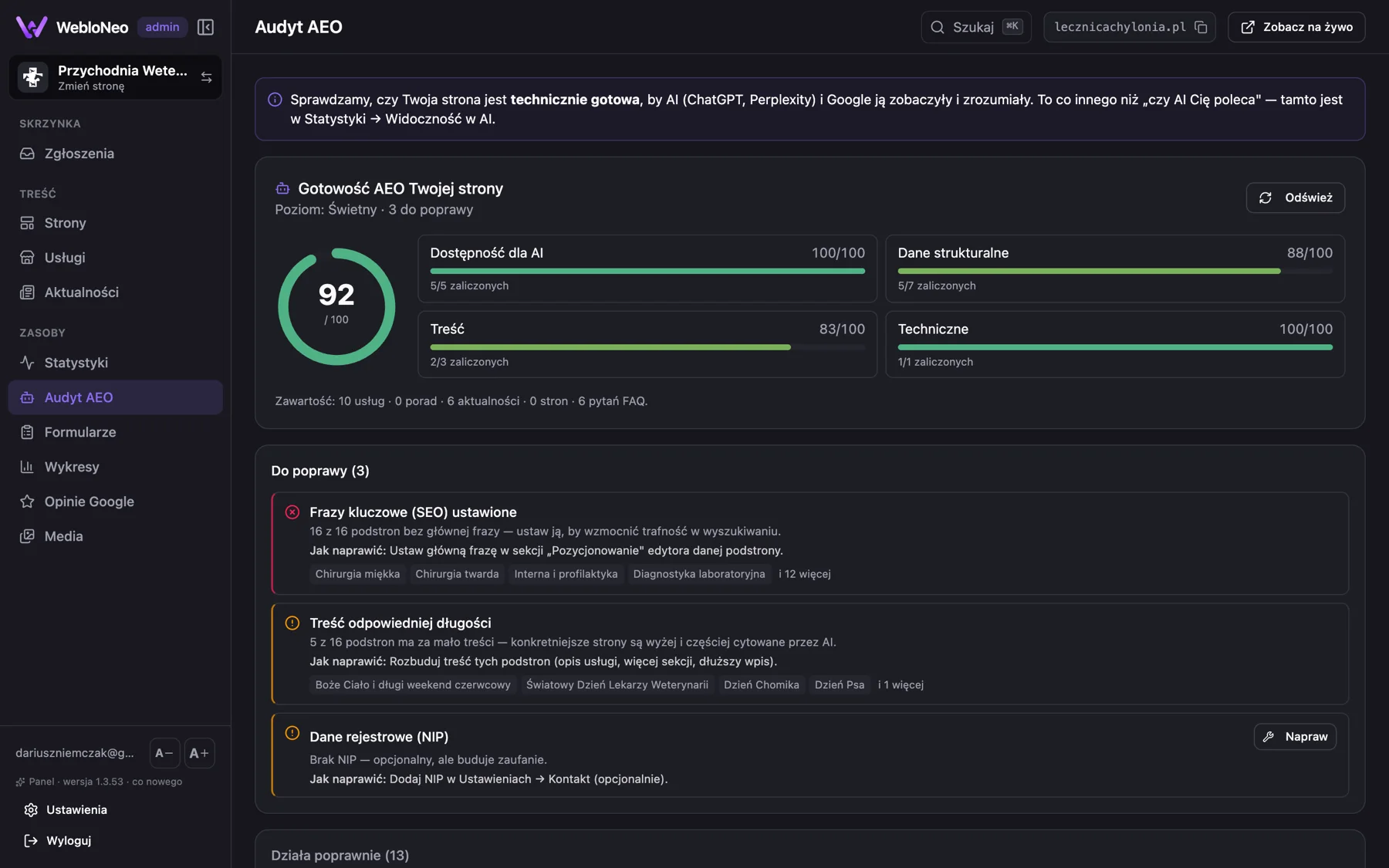
Instead of taking anyone at their word, you get a concrete result: whether AI crawlers are allowed on the site, whether the content is in a format a model can quote, whether the structured data is complete and whether the site is accidentally blocking its own indexing.
The audit shows strengths, gaps and a list of fixes. It is the same measurement we run on our own deployments.
Questions about visibility in AI
How do I know AI search engines really read my site?
From the counter in the panel. You see every crawler separately, its visit count and a comparison with the previous period. That is a measurement, not a declaration. On one deployment, twelve different AI crawlers visited the site over thirty days, more than two thousand times in total.
How is AEO different from SEO?
SEO makes sure a site ranks high in search results. AEO makes sure AI systems can read it, understand it and name it as the source of an answer at all. Today you need both, because some questions never reach the list of blue links.
Is the content on the site written by artificial intelligence?
No. The content comes out of a conversation with the client and is written for that specific company. AI is on the other side: the point is that AI assistants can read that content and recommend it when someone asks about such a service.
We will check how AI sees you
Tell us what site you have today. We will say what can be done with it.